Views: 157 Author: Site Editor Publish Time: 2026-09-03 Origin: Site


A pilates cadillac represents a high-ticket, high-footprint investment for any clinical practice, boutique studio, or premium home gym. It demands significant floor space and careful capital allocation. Choosing the wrong equipment leads to severe safety liabilities. Structural wobbling during advanced suspension exercises terrifies clients. Poor build quality ultimately ruins client retention and damages your brand reputation. We created this guide to solve these exact problems. It provides a comprehensive clinical and commercial evaluation framework. You will learn how to properly assess hardware durability, frame materials, and vital space requirements. We also guide you on vetting manufacturers before you commit to a purchase. By following these steps, you secure a safe, stable, and highly functional environment. Your clients will feel completely secure during every acrobatic or rehabilitative movement.
Identify Your Need: Assess whether a standalone Cadillac or a Reformer Trapeze Combination (RTC) better serves your client demographic and floor plan.
Prioritize Frame Stability: Premium frame materials—specifically evaluating a Pilates Cadillac beech or maple wood Cadillac—dictate the longevity and safety of the apparatus.
Check Exact Specs: Strict adherence to Pilates Cadillac specifications (especially ceiling height and canopy footprint) is non-negotiable for safe installation.
Vet the Source: Your Pilates Cadillac supplier must offer commercial-grade warranties, clear shipping protocols, and reliable replacement parts.
Determining your core business need forms the foundation of your equipment choice. You must decide if you need dedicated suspension and rehabilitation equipment. Alternatively, you might require space-saving hybrid versatility. Studio owners often face a dilemma between dedicating floor space to a single-use apparatus or investing in a multi-use station. Analyzing your primary client demographic helps clarify this decision instantly.
Standalone Cadillac models offer distinct advantages for specialized practices. They provide maximum canopy height and an unrestricted, stable bed space. These features are ideal for elderly clients, mobility-impaired individuals, or advanced acrobatic practitioners. A stationary bed removes the fear of a moving carriage. Clients undergoing physical therapy feel much safer during their rehabilitation sessions. The elevated height also prevents instructors from straining their backs during hands-on adjustments.
Reformer Trapeze Combinations (RTC) present a practical compromise for smaller spaces. An RTC offers standard Reformer functionality alongside tower capabilities. However, you must account for transition times between modes. Instructors need a few minutes to convert the apparatus during a session. RTC models also frequently sacrifice some overhead frame height to maintain structural balance. This height reduction can limit advanced hanging exercises for taller clients.
Use this decision matrix to guide your final choice:
Choose a standalone apparatus for dedicated clinical rehabilitation environments.
Select a standalone unit if you run high-volume, specialized private sessions.
Opt for an RTC if your studio has limited square footage.
Choose an RTC if your business model relies heavily on multi-use training stations.
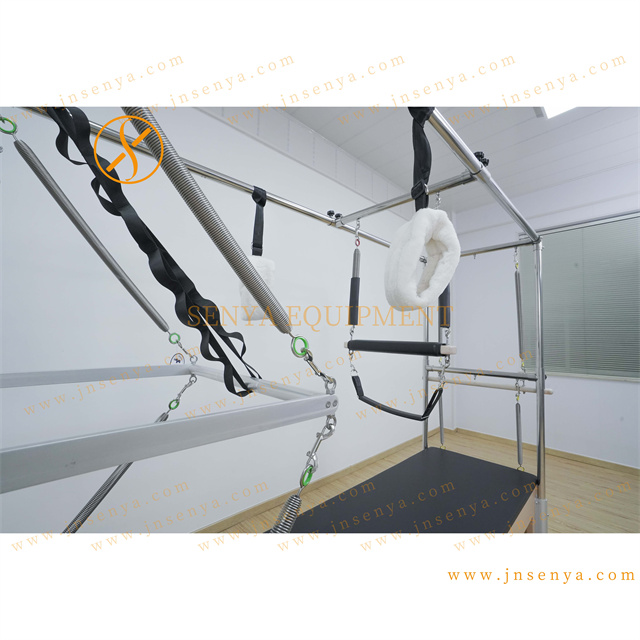
Frame material dictates the longevity, acoustic profile, and visual appeal of your equipment. Maple remains the industry gold standard for studio apparatuses. It offers incredible durability and natural resistance to warping. Maple handles dynamic sheer forces beautifully when clients perform aggressive hanging movements. It absorbs vibration, keeping the studio environment quiet and focused.
Beech serves as a highly durable, cost-effective alternative to maple. When evaluating your options, looking into a pilates cadillac beech maple wood cadillac helps you compare top-tier structural rigidity. Beech provides excellent shock absorption. It maintains joint stability over decades of heavy commercial use. Oak also offers extreme hardness but can be overly heavy and prone to splintering if improperly sealed.
You must watch out for structural red flags during your evaluation. Avoid softwoods like pine entirely. Steer clear of unbranded composite materials or cheap plywood cores. These inferior materials compress over time. They compromise joint stability and cause the frame to creak under heavy loads. Always demand solid hardwood construction for commercial applications.
The overhead metal canopy bears extreme weight and multidirectional tension. Tubing requirements are strict. You should look for heavy-gauge stainless steel or premium anodized aluminum canopies. Galvanized steel introduces significant risks. It can pit, flake, or rust in humid studio environments. Sweaty hands and daily cleaning chemicals accelerate this degradation rapidly.
Joint gussets require equally rigorous inspection. Canopy corners must feature reinforced corner joints. Die-cast metal fittings are highly preferable. They prevent the frame from swaying during hanging exercises. A wobbly canopy instantly destroys client trust. Instructors cannot safely teach aerial movements if the upper hardware exhibits any lateral shifting. Secure, bolted gussets ensure absolute rigidity.
Evaluating exact Pilates Cadillac specifications ensures seamless studio integration. Standard standalone models average 85 to 90 inches in length. Their width generally spans 28 to 30 inches. However, the physical footprint only represents part of the spatial requirement. You must ensure a minimum 2-foot buffer around the entire perimeter. Instructors need this clearance to spot clients safely and change springs.
Ceiling height represents the most crucial safety metric. Standard canopy heights average 82 to 86 inches. A minimum ceiling height of 9 to 10 feet is absolutely mandatory. This clearance allows clients to safely execute advanced aerial movements. If ceilings are too low, clients risk severe head injuries during upward extensions. Never compromise on vertical clearance.
Dimension Type | Standard Measurement | Practical Application |
|---|---|---|
Apparatus Length | 85" – 90" (215cm – 228cm) | Accommodates taller clients comfortably during full supine extensions. |
Apparatus Width | 28" – 30" (71cm – 76cm) | Provides ample bed space for rolling and rotational mat work. |
Perimeter Buffer | Minimum 24" (60cm) | Allows instructors to walk around the unit for spotting and adjustments. |
Ceiling Clearance | 9 to 10 feet | Ensures safe execution of hanging exercises and trapeze acrobatics. |
Clinical standards dictate the internal composition of the bed mat. High-density EVA foam is essential. It prevents the padding from "bottoming out" during kneeling or standing exercises. If the foam is too soft, clients will feel the hard wooden base beneath them. This causes joint pain and disrupts their neuromuscular focus.
Vinyl quality matters just as much as foam density. You should look for marine-grade, antimicrobial vinyl. This material resists tearing, punctures, and daily degradation. Studios use heavy cleaning protocols between clients. Cheap vinyl dries out, cracks, and flakes when exposed to sanitizing sprays. Premium upholstery guarantees a pristine, hygienic surface for years.
Spring mechanics form the heart of the Pilates method. Spring quality directly impacts the smoothness of every movement. You must require nickel-plated or high-carbon stainless steel springs. These metals resist oxidation and snap-back. Color-coded tension indicators are also mandatory for quick, accurate resistance changes during fast-paced sessions.
Consistency in resistance is paramount. Springs should offer linear resistance without snapping. They must not slacken at extension peaks. Your evaluation checklist must cover all spring categories. You need dedicated leg springs, arm springs, push-through springs, and trapeze springs. Each type requires precise calibration. Check for any metal fatigue or squeaking during initial testing.
Leg Springs: Longer, heavier tension for lower-body stabilization.
Arm Springs: Lighter, more responsive tension for shoulder girdle articulation.
Push-Through Springs: Multi-directional tension used for deep spinal flexion.
Trapeze Springs: Extremely heavy tension designed to support full body weight.
The push-through bar serves as a primary point of interaction. You must evaluate its pivot points carefully. The bar must consist of anodized aluminum or solid wood. It requires safety straps for top-loaded exercises. The hinges must remain quiet and frictionless. Squeaky hinges ruin the meditative flow of a private session.
Slider systems dictate vertical and horizontal adjustments on the canopy. Ensure all slider bars lock securely. They must not rattle during use. A common mistake is ignoring thread quality on the locking knobs. Poorly machined threads strip over time. This makes the sliders dangerous or impossible to tighten. Always test the sliding mechanism for smooth, binding-free movement.
Finding a dependable Pilates Cadillac supplier protects your investment long-term. You should look for a minimum 5-to-10-year warranty on the structural hardwood frame. Mechanical parts and springs generally carry a 1-to-2-year warranty. These timelines reflect industry confidence in commercial-grade manufacturing. Avoid manufacturers offering warranties under one year.
Compliance documentation verifies manufacturing standards. Verify if the equipment holds CE marks. Check for ISO certifications related to commercial fitness or medical devices. These certifications prove the manufacturer uses standardized safety protocols. Clinical environments often require these documents for insurance purposes. Proper compliance ensures you avoid future liability issues.
Logistics require careful planning. These large units always ship via freight. Confirm if the supplier provides standard liftgate delivery or premium white-glove assembly. Crates weigh hundreds of pounds. Moving them from the curb into your studio requires significant manpower. Detailed video assembly instructions are essential if you choose self-installation.
Parts availability separates excellent suppliers from mediocre ones. A trustworthy supplier maintains a domestic or highly accessible inventory. You will eventually need replacement springs, fuzzies, safety chains, and foot straps. Waiting months for international replacement parts causes costly machine downtime. Ensure your chosen brand offers a streamlined, responsive aftercare service portal.
Choosing the right apparatus requires a strict, methodical approach. Do not compromise on frame material or canopy stability just to save on initial costs. A wobbling canopy destroys client trust instantly and introduces severe liability. Prioritize premium hardwoods and die-cast metal joints for absolute safety.
Your next steps involve actionable studio planning. First, measure your studio's ceiling height precisely to ensure a 9-foot minimum clearance. Second, request material samples or spec sheets from your top two suppliers to compare build quality. Finally, calculate your potential return on investment based on your specific private session pricing and local demographic demand.
A: Minimum 9 feet, preferably 10 feet, to allow sufficient clearance for hanging exercises and trapeze work.
A: Both are premium hardwoods. Maple is traditionally denser and the industry standard, while beech offers nearly identical structural integrity and aesthetic appeal often at a slightly more competitive price point.
A: Yes. Despite its imposing appearance, it is highly effective for beginners and rehab patients because the elevated bed and spring assistance provide unparalleled support.
A: For commercial studios, springs should be inspected monthly and replaced every 12 to 24 months depending on usage volume to prevent metal fatigue.


