Views: 137 Author: Site Editor Publish Time: 2026-09-10 Origin: Site


A ladder barrel stands as a core investment for any professional Pilates studio or clinical practice. Selecting an incompatible configuration often creates severe space bottlenecks. It also limits the specific demographic of clients you can successfully serve. Unlike traditional reformers, this specialized apparatus relies entirely on precise spatial dimensions. It demands absolute rigid stability. You need these physical elements to support deep spinal extension and flexion exercises safely. If the structural dimensions fail your client's body mechanics, movement efficacy drops immediately. This guide provides a purely objective, decision-stage framework. You will learn to evaluate critical spatial footprints and compare solid building materials. We help you analyze various adjustment configurations effectively before you commit to your next apparatus purchase.
Assess your project’s primary demographic: modern adjustable bases accommodate broader height variations, while fixed classical designs prioritize traditional flow.
Reviewing exact ladder barrel specifications (footprint, rung spacing, barrel arc) is non-negotiable for studios with limited square footage.
Material integrity dictates lifespan; a beech wood pilates ladder barrel offers the optimal balance of weight, structural rigidity, and resistance to environmental warping.
Evaluating a ladder barrel supplier should focus on warranty terms, commercial liability compliance, and replacement part availability, rather than just upfront cost.
You must first define clear success criteria based on your primary operating environment. Identifying your core use case directly dictates the necessary hardware features you need. A busy downtown studio demands entirely different structural tolerances than a private physical therapy room.
High-traffic commercial studios require extreme durability and seamless operation. You need quick-adjust mechanisms on all equipment. Instructors rely on rapid client transitions during intense group classes. You cannot waste three minutes adjusting a heavy wooden frame. Commercial-grade upholstery is also absolutely non-negotiable. Staff must easily wipe down and sanitize surfaces between back-to-back sessions without degrading the vinyl.
Physical therapists and rehabilitation clinics prioritize highly granular adjustability. You need precise control over the distance between the barrel and the wooden ladder. This flexibility ensures patients safely perform rehabilitation movements regardless of their physical limitations. Clinical settings often handle clients suffering from severe mobility restrictions. Your equipment must adapt to the patient, rather than forcing the patient to adapt to a rigid apparatus.
Footprint optimization takes center stage in boutique and home setups. These smaller spaces demand clever spatial planning and high aesthetic integration. However, you cannot sacrifice functional stability just to save a few inches of floor space. The apparatus must remain heavy enough to prevent tipping during advanced side-bending exercises.
Audit your daily class schedules to determine adjustment frequency.
Calculate the average height variance among your current client base.
Assess your cleaning protocols to determine upholstery durability needs.
Measure your distinct studio zones to ensure adequate traffic flow.
Understanding precise dimensions prevents crowded floors and dangerous collision zones in your studio. You must evaluate the physical geometry of the apparatus before considering any aesthetic features.
Standard dimensions typically measure around 47 inches long, 36 inches wide, and 39 inches high. However, you cannot simply measure the physical footprint of the wood. You must assess your entire floor plan. Experts recommend allowing a minimum 2-foot safety clearance on all sides of the apparatus. Clients need ample room to swing their legs overhead or perform wide sweeping arm movements without striking nearby walls or other reformers.
You must carefully evaluate the curvature of the padded barrel. Steeper arcs suit highly advanced practitioners. These acute angles often appear in classical designs to challenge deep spinal articulation. Conversely, gentler arcs serve general populations much better. A softer curve provides greater lumbar support for beginners or older clients lacking extreme spinal flexibility.
Pay close attention to the number of wooden rungs and the vertical distance between them. Most units feature either four, five, or six rungs. Proper vertical spacing ensures safe foot placement and secure hand grips. A well-designed rung configuration accommodates clients of varying bodily proportions. If rungs sit too far apart, shorter clients will struggle to hook their feet securely during extension exercises.
Placing the apparatus directly against a mirror, limiting front-facing exercises.
Ignoring the swing radius needed for advanced ballet stretches.
Failing to account for the instructor's physical spotting position.
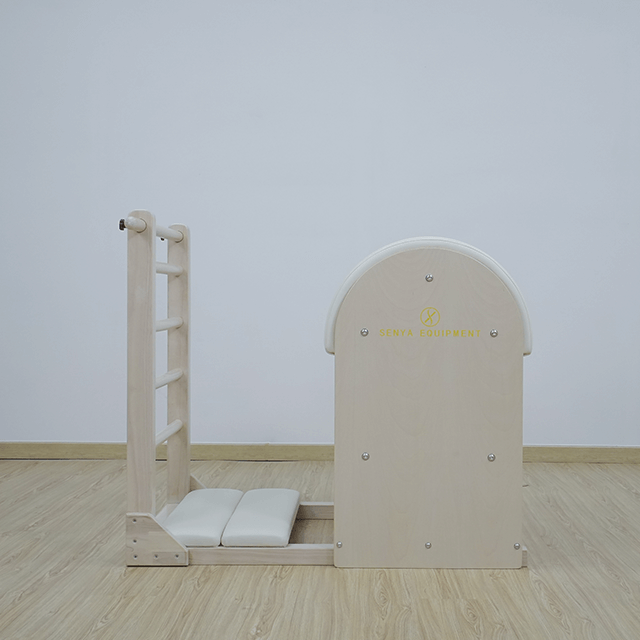
The raw materials used in construction dictate the functional lifespan of your apparatus. Frame density directly controls how the equipment handles dynamic forces during daily operations.
You should vigorously contrast standard softwoods against premium hardwoods. Softwoods like pine are highly prone to internal micro-fractures under heavy compression. Beech wood remains the recognized industry standard for commercial Pilates apparatuses. It offers exceptionally high density and superior shock absorption. Furthermore, beech wood resists environmental humidity variations beautifully. This prevents the frame from warping or splintering in heavily air-conditioned or heated studios.
The barrel padding endures intense localized pressure. High-density EVA foam prevents the barrel from "bottoming out" during heavy bodily compression. For instance, during a side sit-up, a client's entire body weight rests on a small surface area. Inferior open-cell foam flattens quickly over time. High-quality closed-cell foam retains its supportive shape for years while resisting sweat absorption.
Look specifically for authentic mortise-and-tenon joints across the wooden frame. These traditional joinery methods prevent structural shifting under lateral loads. You must also verify the presence of heavy-duty steel mechanisms on all moving parts. Weak aluminum tracks warp quickly, causing the sliding base to jam unexpectedly during classes.
Material Type | Durability Level | Weight Stability | Humidity Resistance | Best Use Case |
|---|---|---|---|---|
Softwood (Pine/Spruce) | Low | Light (Prone to tipping) | Poor (Prone to warping) | Light residential use only |
Premium Beech Wood | High | Heavy (Excellent stability) | Excellent | Commercial and clinical studios |
Tubular Steel | Very High | Moderate to Heavy | Excellent (If rust-treated) | Industrial gym environments |
Plywood Composites | Moderate | Moderate | Varies by sealant | Budget home setups |
The adjustability debate shapes how clients interact with your equipment. Your choice between fixed and sliding bases dictates the overall flow of your daily sessions.
Fixed-base configurations are modeled strictly after Joseph Pilates' original dimensions. These units offer maximum structural stability because they lack moving tracks. They force the practitioner to adapt their body to the apparatus. This builds intense core discipline. Fixed designs work best for boutique studios strictly teaching traditional, classical Pilates methodologies. They require zero adjustment time, keeping class pacing incredibly brisk.
Modern configurations feature a dedicated track or a slot-and-knob system. This allows the upholstered barrel to slide closer to or further from the wooden ladder. A highly versatile ladder barrel proves absolutely essential for accommodating a wide range of human heights. You can comfortably serve a 4'10" gymnast and a 6'4" basketball player on the exact same piece of equipment within minutes.
You must rigorously evaluate the physical security of all adjustment knobs and levers. Quick-release levers dramatically speed up class flow between exercises. However, they must lock tightly and securely. If a lever slips under horizontal load during a back extension, the client will fall. Always test the friction plates and locking pins for absolute rigidity before allowing clients on the apparatus.
Digital blueprints and DIY fabrication guides frequently tempt budget-conscious studio owners. However, building an apparatus from scratch carries severe operational risks.
We acknowledge the wide availability of digital schematics online. For a hobbyist woodworker, crafting their own fitness equipment sounds like an exciting weekend project. The initial material cost appears surprisingly low compared to buying retail. Many home users pursue this route hoping to achieve studio-quality workouts on a tight budget.
Material sourcing and precision carpentry requirements quickly drain your time and resources. Achieving the perfect anatomical barrel arc demands highly advanced woodworking skills and specialized steaming equipment. Mistakes in rung spacing or joint gluing compromise the entire build. These frequent errors and subsequent material replacements often offset any initial financial savings completely.
In a commercial or clinical setting, DIY equipment builds immediately invalidate your professional liability insurance. Commercial policies require equipment to carry official manufacturing certifications. Only professionally manufactured apparatuses undergo rigorous factory load-testing. If a client injures themselves on a homemade wooden frame, your business assumes complete legal liability for the mechanical failure.
Finding a reliable manufacturing partner ensures smooth daily operations. You need a vendor capable of supporting your business as it scales.
You must ask if the manufacturer provides transparent load-testing data. Reliable brands adhere to ISO or equivalent international manufacturing standards. They test their frames against thousands of repetitive stress cycles. This documentation proves the equipment handles heavy, dynamic forces without catastrophic joint failure.
A reputable brand should offer a comprehensive multi-year warranty on the main wooden frame. They must also provide a realistic warranty covering the upholstery and steel moving parts. Look for companies that guarantee replacement part availability for several years. You do not want to replace an entire unit simply because a unique locking lever broke.
Evaluate their primary shipping methods carefully. LTL freight shipping generally protects large wooden items better than standard parcel services. You must also determine if the equipment ships fully assembled. Complex on-site assembly by untrained studio staff frequently introduces severe structural weaknesses. Pre-assembled frames glued and clamped in a factory setting always offer superior lateral strength.
Selecting the ideal configuration requires balancing structural stability, adjustability, and available floor space. Matching the apparatus to your specific client demographic ensures safety and maximizes daily usage. By prioritizing premium hardwoods and commercial-grade padding, you protect your studio against premature equipment degradation. Choosing between classical fixed models and modern sliding bases ultimately depends on your teaching methodology and client height variations.
To move forward confidently, take these actionable next steps:
Audit your physical floor space, mapping out the necessary 24-inch safety clearance zones.
Determine your strict requirement for adjustability based on your tallest and shortest regular clients.
Decide between a steeper classical arc for advanced users or a gentler arc for clinical rehabilitation.
Request detailed material specification sheets from your shortlisted equipment manufacturers.
A: A professionally manufactured commercial unit typically supports between 300 and 350 lbs. This capacity depends heavily on the internal joint construction and the specific wood species used. Hardwoods like beech provide significantly higher dynamic load ratings compared to standard softwoods or composite materials.
A: We strongly recommend maintaining a minimum clearance of 24 inches on all four sides of the apparatus. This empty buffer zone allows clients to execute their full range of motion safely. It also provides instructors enough physical room to spot clients during complex inversions.
A: It largely depends on the intended users. If multiple family members of significantly different heights plan to use the equipment, a sliding base is highly recommended. It allows quick adjustments to match differing leg lengths, ensuring safe and effective spinal extensions for everyone.
A: You should regularly wipe the vinyl upholstery with non-abrasive, antibacterial solutions to prevent sweat degradation. Avoid harsh chemical solvents that dry out the foam. For the wooden frame, conduct periodic visual checks on all hardware tightness and clean the wood finish with a dry microfiber cloth.


