Views: 168 Author: Site Editor Publish Time: 2026-08-31 Origin: Site


Outfitting a professional studio or clinical practice involves a significant capital expenditure. Studio owners frequently encounter severe operational risks when they accidentally purchase residential-grade equipment disguised as commercial machines. These purchasing missteps inevitably lead to frequent breakdowns, dangerous liability issues, and poor client retention rates. You simply cannot afford unpredictable downtime during peak class hours.
This guide provides a strict, evidence-based evaluation framework to help you navigate the equipment procurement process safely. We will help you translate technical Pilates reformer specifications into long-term business ROI and highly reliable client experiences. You will learn exactly how to assess structural integrity, evaluate carriage glide systems, and verify warranty terms. By understanding these core elements, you protect your initial investment and create a professional environment built for sustainable growth.
Frame integrity dictates lifespan: Commercial environments require high-grade aluminum or solid hardwood to withstand 8–12 hours of daily use.
Resistance consistency equals quality: Premium music wire or nickel-plated springs prevent tension degradation and ensure consistent client progression.
Space is revenue: Commercial pilates reformer studio use demands a strategic choice between stackable, foldable, or rigid frames based on square footage and class size.
Vetting the supplier matters as much as the spec: True commercial value is found in accessible replacement parts, transparent warranties, and a reliable Pilates reformer supplier.
The foundation of any Pilates reformer dictates its maximum weight capacity, daily maintenance overhead, and overall studio aesthetic. You must evaluate the frame material based on your specific business model. Extruded anodized aluminum serves as the optimal choice for high-traffic group classes. Aluminum frames remain lightweight, highly resistant to sweat and corrosion, and frequently offer stackable designs. This allows instructors to clear the floor quickly for mat sessions.
Conversely, solid hardwood frames crafted from maple, beech, or oak deliver a premium aesthetic tailored for clinical rehabilitation or private one-on-one settings. Wood naturally provides a warmer, grounding feel. However, hardwood requires thicker joints and specialized marine-grade finishing to prevent warping caused by humidity over time. Do not compromise on joint construction if you select a wood model.
A genuine commercial-grade machine must support a minimum dynamic working load of 300 to 350 lbs (136 to 158 kg). This capacity ensures inclusivity for diverse client demographics while offering robust liability protection. Avoid composite woods or thin-gauge metals entirely. These materials inevitably flex under heavy lateral loads during advanced exercises. Such flexing leads to structural micro-fractures in the frame, creating safety hazards and forcing premature replacement.
The carriage engineering directly impacts client perception. A jerky or noisy carriage feels cheap and actively degrades the workout experience. Clients pay premium rates for smooth, frictionless movement. You must scrutinize the glide system closely to ensure it meets professional expectations.
Focus your evaluation on three key dimensions:
Rail Design: Prioritize C-channel aluminum rails over flat outer rails. The C-channel design prevents dust and hair buildup while keeping the wheels securely tracked inside the extrusion.
Wheel Mechanisms: Specify an eight-wheel system. This configuration usually includes four vertical support wheels and four horizontal guide wheels. Demand high-grade polyurethane wheels to guarantee frictionless, silent operation across thousands of travel cycles.
Carriage Padding: Look for high-density EVA foam. EVA foam provides the firm support necessary for proper spinal alignment during supine exercises. Ensure marine-grade, sweat-resistant vinyl covers the foam to prevent cracking and facilitate rapid sanitation between classes.
Always perform a skeptical check on carriage travel distance. Commercial standards strictly require at least 40 inches (100 cm) of travel. This extended range comfortably accommodates clients over 6’2” (188 cm) tall, ensuring no one feels restricted during legwork routines.
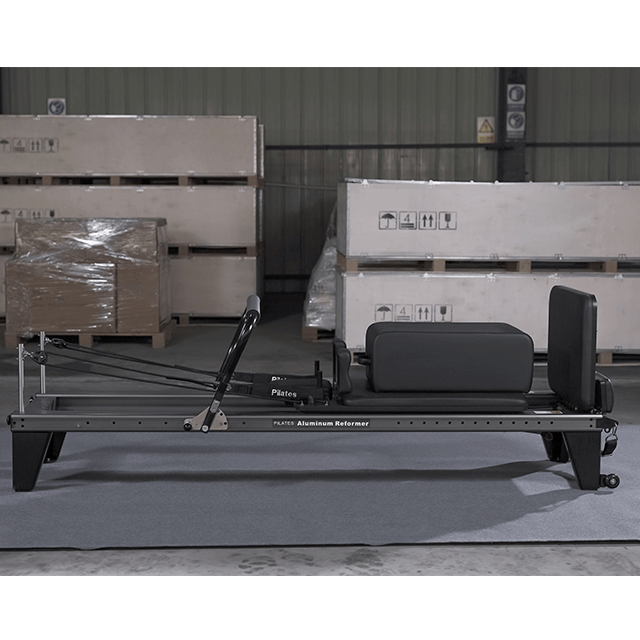
Spring systems function as the engine of your equipment. Choosing the right specifications directly reduces recurring maintenance costs and ensures absolute tension safety for your clients.
Spring material serves as the first evaluation metric. Demand high-carbon steel, music wire, or nickel-plated springs. Standard untreated steel oxidizes quickly and loses tensile strength rapidly in humid commercial environments. When springs lose their tension, clients experience uneven resistance curves, which disrupts their physical progression and increases injury risks.
The standard commercial configuration utilizes a five-spring setup. Studios typically use three heavy springs, one medium spring, and one light spring. This precise arrangement provides the granular resistance scaling required for varying strength levels. Furthermore, the machine must feature a multi-position gear bar offering at least three to four locking positions. A multi-position gear bar lets instructors safely adjust initial spring tension for taller or stronger clients without altering the neutral resting point of the carriage.
Acknowledge the implementation reality regarding resistance components. Springs remain consumable wear parts. Budget for full replacement every 2,000 to 3,000 hours of active use. Disregard marketing claims promising lifetime springs. Proactive replacement prevents dangerous mid-exercise snapping and maintains the premium feel of the machine.
In group fitness environments, efficiency equals profitability. Ergonomics and rapid adjustability minimize transition times between exercises, thereby increasing the flow and overall capacity of your classes. If an instructor wastes two minutes adjusting footbars for ten clients, you lose valuable teaching time.
Examine the footbar mechanics thoroughly. Look for one-handed adjustment systems utilizing secure locking pins. Avoid friction-only locks entirely in commercial settings due to severe liability risks. A footbar collapsing during a plank exercise can cause severe injury. Additionally, evaluate the rope and pulley systems. Retractable rope setups featuring quick-release nautical cleats save instructors valuable minutes during complex class transitions compared to traditional D-ring strap adjustments.
Riser height adjustability also matters greatly. Adjustable or removable pulleys allow instructors to vary the angle of resistance dynamically. This feature proves essential for clinical rehabilitation scenarios where specific joint angles require precise tension loads.
Comparison of Adjustability Features in Studio Equipment
Component | Standard Configuration | Commercial Configuration | Business Impact |
|---|---|---|---|
Footbar Locks | Friction-based dials | One-handed secure pins | Mitigates injury liability and speeds transitions. |
Rope Adjustments | D-rings and clips | Quick-release cleats | Eliminates class downtime between exercises. |
Pulley Risers | Fixed height | Adjustable / Removable | Expands rehab and clinical exercise capabilities. |
Space optimization directly maximizes the ROI per square foot of your leased commercial space. A well-planned floor layout dictates how many clients you can serve simultaneously without compromising safety or comfort.
Begin by calculating the exact footprint. Standard commercial models generally measure around 94 inches in length and 26 inches in width. However, you must calculate dynamic clearance. You need a minimum of two feet (60 cm) of unobstructed space around every machine. This vital clearance allows instructors to correct client form safely and provides clients with enough room for sweeping arm and leg movements.
If your studio serves dual purposes—such as alternating between mat classes and equipment sessions—you must evaluate storage solutions carefully. Stackable models featuring lighter aluminum frames offer excellent versatility. Heavy-duty folding mechanisms present another option for commercial pilates reformer studio use.
Apply a skeptical check when evaluating foldable units. Folding mechanisms inherently introduce a structural weak point in the frame. If you decide to choose a foldable commercial unit, demand to see rigorous stress-test data specifically for the center hinge joint. Do not accept consumer-grade hinges in a professional setting.
Selecting the right vendor guarantees machine uptime and heavily protects your initial capital investment over a five-to-ten-year horizon. A solid specification sheet means very little if the manufacturer cannot support the product post-sale.
Watch out for common warranty traps. You must differentiate between a frame warranty and a wear parts warranty. Frame warranties often span a lifetime, sounding impressive on paper. However, wear parts warranties—covering springs, marine-grade vinyl, and ropes—usually last only 90 days to one year. Understand exactly what your coverage includes before signing the purchase order.
Investigate the supply chain and sourcing practices of your chosen Pilates reformer supplier. Whether you buy from a recognizable legacy brand or a direct-from-factory OEM in China, you must verify the exact lead time for replacement parts. A broken machine sitting idle on the floor costs you daily revenue and damages your brand reputation. Fast part accessibility is non-negotiable.
Finally, confirm manufacturing compliance. Check for ISO manufacturing certifications or standardized CE marks. These credentials ensure the equipment meets basic international mechanical safety standards, protecting you from negligence claims.
Sourcing a commercial pilates reformer requires balancing upfront capital expenditure against long-term operational reliability. Professional environments demand premium materials, precise engineering, and accessible replacement parts to keep classes running smoothly.
Take the following action steps before finalizing your equipment purchase:
Request a single physical sample if you plan on buying in bulk directly from an OEM factory.
Test the carriage glide in person to verify the C-channel tracking and polyurethane wheel smoothness.
Demand a written Service Level Agreement (SLA) guaranteeing specific lead times for replacement springs and upholstery before you sign any contract.
Map your studio floor plan using the precise dimensions and required clearance zones to verify your maximum capacity.
A: Commercial units use thicker frame materials, heavy-duty polyurethane wheels, and higher-grade springs designed for continuous 8+ hour daily use. Home units are lighter, often shorter, and lack the durability for studio volume.
A: In a busy studio setting, springs should be proactively replaced every 18 to 24 months (or roughly 2,000–3,000 hours of use) to prevent sudden snapping and maintain tension integrity.
A: Yes, but only if they feature commercial-grade locking hinges and reinforce the center frame. They are ideal for hybrid studios, though rigid frames generally offer superior long-term durability for dedicated reformer studios.


