Views: 142 Author: Site Editor Publish Time: 2026-09-06 Origin: Site


Purchasing a Pilates chair represents a significant capital expenditure for commercial studios and serious home practitioners alike. Top-tier equipment forms the very backbone of any effective movement practice. However, premature equipment failure leads to severe headaches across the board. Weak components create immediate safety liabilities for your clients. They also disrupt tight class schedules and force sudden, stressful replacements. You need gear you can rely on every single day.
We must move beyond simple aesthetic preferences to evaluate real structural integrity. In this guide, you will explore material lifecycles, load tolerances, and hardware engineering. Ultimately, this knowledge empowers you to make a highly confident, long-lasting purchasing decision.
Frame integrity dictates lifespan: The choice between solid wood and high-gauge steel fundamentally shifts the chair's weight capacity, maintenance needs, and environmental resilience.
Spring quality is non-negotiable: High-carbon steel springs with secure anchor points prevent tension loss and safety hazards over thousands of cycles.
Upholstery requires commercial grading: Medical-grade vinyl resists sweat degradation and daily friction far better than standard PU leather.
Supplier reliability matters as much as materials: Partnering with a vetted supplier ensures accurate specifications, warranty enforcement, and long-term parts availability.
The core chassis of your equipment dictates its absolute baseline for survival. When you subject a frame to dynamic human weight, it undergoes immense sheer force. Choosing the right foundational material dictates how well the apparatus absorbs this daily punishment.
Hardwood remains a beloved staple in the industry. It offers a deeply traditional, warm aesthetic. Many instructors prefer the organic, grounded feel it provides during class.
Pros: Excellent natural rigidity characterizes premium hardwoods. They provide tremendous aesthetic warmth. They also deliver a classic, authentic studio feel.
Risks/Considerations: Wood acts as a porous, living material. It remains highly susceptible to humidity fluctuations. Poorly joined pieces develop micro-cracks over time. You must maintain precise climate control in your facility to protect it.
Success Criteria: Look closely at the construction methodology. You must insist on structural dowel joints. Manufacturers should apply high-grade industrial adhesives. They must also seal the wood using moisture-resistant commercial lacquers.
Metal frames offer a distinctly modern approach to equipment engineering. They strip away organic vulnerabilities. In return, they deliver pure, unyielding structural uniformity.
Pros: Humidity and temperature changes leave metal entirely unaffected. Metals offer perfect structural uniformity. They easily boast exceptionally high weight thresholds.
Risks/Considerations: Some users feel metal looks too "clinical" or cold. Solid metal components are usually heavier to move around. Rust becomes a serious potential threat if the protective powder-coating gets compromised.
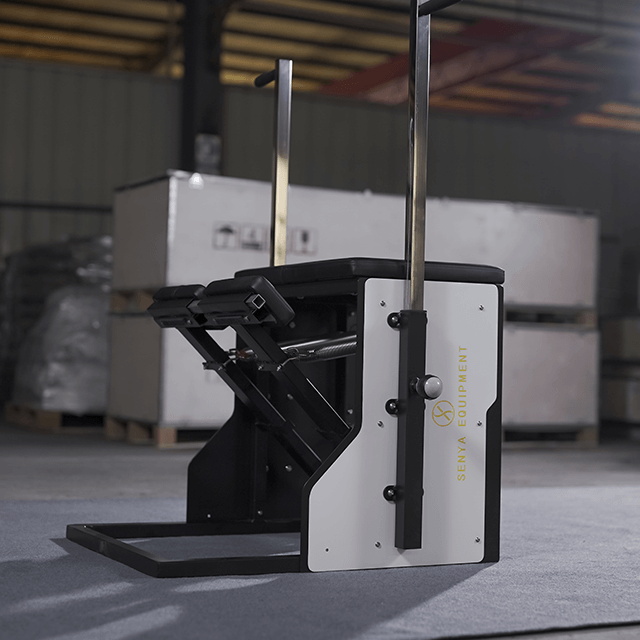
Success Criteria: Consider a heavy-use environment like a steel pilates wunda chair studio. You must demand powder-coated tubular steel. Inspect the connections carefully. Precision welds always outperform basic bolted joints. Welds eliminate the micro-movements responsible for long-term structural loosening.
Material Type | Primary Advantage | Main Vulnerability | Ideal Environment |
|---|---|---|---|
Premium Hardwood (Maple/Beech) | Superior aesthetic, dampens vibration | Humidity fluctuations, loose joinery | Climate-controlled studios, homes |
Tubular Steel | Maximum weight tolerance, rigid | Rust (if scratched), clinical look | High-volume commercial spaces |
Aluminum | Lightweight, rust-resistant | Lower sheer strength than steel | Rehabilitation centers, mobile setups |
You cannot judge a piece of equipment purely by its outer shell. The internal mechanics dictate the actual user experience. These moving parts bear the brunt of every single workout.
Springs serve as the true engine of your apparatus. Understanding spring metallurgy separates professional equipment from amateur gear. Standard iron springs degrade rapidly. They lose their coil memory quickly under heavy load. Conversely, high-carbon, nickel-plated steel springs offer immense resilience.
Tension fatigue represents a massive, often ignored problem. Cheap springs lose resistance after just six to twelve months of commercial use. This tension loss fundamentally alters the biomechanics of the exercise. When resistance drops, clients no longer receive the intended muscular challenge. Furthermore, failing springs pose a severe physical hazard. A snapping coil can cause terrible injuries mid-movement.
The pedal hinges endure thousands of pivoting motions every week. You must rigorously evaluate the hinge mechanisms on split-pedal designs.
Check the Bearings: Look specifically for industrial-grade enclosed bearings. These components ensure silent, frictionless movement over time. Cheap sleeves squeak and grind down quickly.
Examine the Connections: Compare the hardware connections closely. Heavy-duty carabiners and steel eye-hooks are non-negotiable. Cheap plastic clips or light-alloy alternatives simply will not survive a commercial setting.
Test the Pedal Stability: Apply lateral pressure to the split pedals. They should move independently but exhibit zero sideways wobble.
Top-tier manufacturers maintain strict engineering standards across their entire product lines. They use the exact same industrial-grade hardware across their whole ecosystem. Therefore, your new chair should effortlessly match the rigorous build quality of a heavy-duty commercial pilates reformer. Hardware consistency guarantees your instructors feel uniform resistance curves across the entire studio.
The surfaces your clients interact with determine their immediate comfort. Upholstery takes constant abuse from sweat, friction, and compression. Selecting the right materials prevents your equipment from looking ragged after a few short months.
Standard upholstery foam fails miserably in an athletic setting. It suffers from a condition known as "bottoming out." When a user stands on standard foam, it compresses completely. The user's bones then press directly against the rigid wood underneath. Standard foam also retains permanent indentations over time.
You must define a higher standard for your padding. High-density EVA foam or closed-cell rebonded foam provides the exact necessary firmness. These advanced foams support heavy standing or kneeling exercises. They rebound instantly. They do not degrade, flatten, or warp under continuous heavy loads.
Studio environments represent harsh chemical realities. Your upholstery faces a daily onslaught. Sweat, acidic body oils, and harsh sanitizing cleaning agents attack the fabric continuously.
Standard PU (polyurethane) leather breaks down rapidly under these conditions. It dries out, cracks, and flakes off in unsightly patches. We strongly recommend opting for marine-grade or medical-grade vinyl instead. Medical-grade vinyl offers vastly superior resistance to abrasion. It fights off chemical breakdown effortlessly. It remains supple and strong even after thousands of disinfectant wipe-downs.
Furthermore, you must inspect the stitching. Highlight the importance of double-stitched seams. Single-stitched corners tear easily under high-stress shear forces. Double stitching prevents tearing at vulnerable corners and extends the upholstery's lifespan by years.
No single material wins every category unconditionally. You must match the material directly to your intended environment. Different spaces demand entirely different engineering priorities.
Commercial spaces experience brutal, constant utilization. You will see widely varying user weights throughout the day. Your staff has minimal time for delicate, careful maintenance between rapid-fire classes.
For these environments, we strongly suggest steel frames. Alternately, you must invest in ultra-premium hardwood. Steel absorbs continuous impact without complaint. It provides maximum return on investment and guarantees the absolute lowest failure risk over a ten-year horizon.
Home setups present a different set of challenges. You must emphasize space-saving designs. Quieter operation becomes incredibly important in a residential space. Furthermore, visual integration with existing home decor matters deeply to most homeowners.
Hardwood almost always wins here. It looks like beautiful furniture rather than stark gym equipment. The wood dampens acoustic vibrations perfectly. However, this success relies heavily on one crucial factor. The home environment must maintain stable humidity to prevent the wood from warping.
Before buying, you must guide your purchasing logic carefully. Map your facility's daily user volume directly against the manufacturer's documentation. Analyze the exact Pilates chair specifications. Pay close attention to stated maximum weight limits. Review the specific warranty terms for commercial versus residential use. Mismatched usage voids warranties instantly.
Even the best materials mean nothing if the manufacturer cuts corners during assembly. The company standing behind the product holds as much importance as the steel itself.
A trustworthy manufacturer operates in broad daylight. They will readily provide exact material grades upon request. They will specify the precise steel gauge used in the frame. They will detail their wood sourcing practices. They will happily share foam density metrics. Run away from suppliers relying purely on vague, flashy marketing terms like "ultra-strong" without providing the hard numbers.
Equipment requires maintenance eventually. You must evaluate the long-term availability of replacement parts. Ask yourself a critical question. Can you easily buy replacement springs, pedal hinges, or exact upholstery covers five years from now?
A reputable Pilates chair supplier maintains a robust inventory of modular replacement parts. They understand that swapping a worn pedal hinge makes more sense than replacing an entire machine.
A company's warranty reveals its true confidence in its product. Compare standard industry warranties aggressively. Look for lifetime warranties on steel frames. Expect at least two to three years of comprehensive coverage on moving parts and upholstery.
Warn yourself against suppliers offering complex warranty loopholes. Read the fine print carefully. Shady companies often dismiss glaring structural failures as mere "normal wear and tear." Strong warranties protect your investment and signal high-tier manufacturing standards.
Durability ultimately stands as a composite achievement. It requires robust frame rigidity, tireless spring resilience, and dense, chemical-resistant upholstery. You cannot compromise on one element without jeopardizing the entire apparatus.
Avoiding premature replacement costs easily justifies a higher upfront investment in commercial-grade materials. Cheap equipment always costs more in the long run through repairs, downtime, and client dissatisfaction.
Take action today. Request detailed material spec sheets from your shortlisted vendors. Contact a commercial sales representative to discuss outfitting your specific studio space. Demand transparency, and invest in equipment built to endure.
A: You should generally replace springs every 12 to 24 months in a commercial studio setting. This timeline depends entirely on your daily volume. Watch closely for warning signs. Gapping coils, visible oxidation, or any uneven resistance curves mean you must replace them immediately to ensure client safety.
A: Not necessarily. Weight often correlates with solid wood or dense steel. However, construction methodology matters much more than raw mass. Precision weld quality, superior structural joinery, and intelligent geometric design dictate true durability far better than sheer heaviness.
A: Wipe down the padding immediately after every single use. Always use a manufacturer-approved, pH-neutral cleaner. Harsh chemical bleaches or abrasive scrubs cause the vinyl to harden, crack, and flake. Gentle, consistent cleaning removes acidic sweat and prevents premature material breakdown.


